


Kneeling in the Burning Library
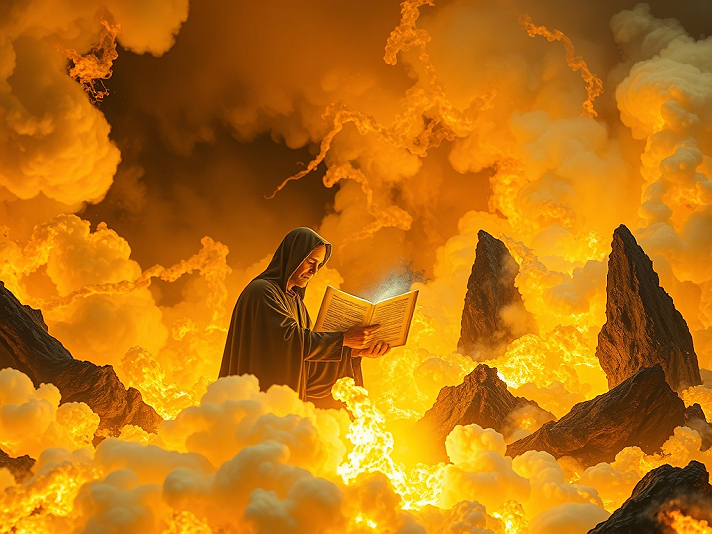
The second image is not a sequel; it is a transfiguration. Where the first painting showed a young man in radiant white standing untouched within a horizontal inferno, this one lifts the entire scene into the vertical axis of judgment and revelation. The reader has aged into a hooded elder, cloaked in black, kneeling upon a landscape that no longer pretends to be earth. What were once jagged rocks have become towering obsidian spires rising through a sea of fire-clouds, and the sky itself has been replaced by a churning furnace of gold and smoke. The flames no longer frame the figure; they have become the firmament. This is not apocalypse observed from within—it is apocalypse become heaven and hell simultaneously, a single molten cathedral where creation and destruction share the same breath.
The hooded man’s posture is the first revelation. He is no longer standing in calm defiance; he is kneeling, not in submission but in reckoning. His knees rest upon a narrow ridge of black stone that juts like a blade through the burning clouds, forcing him into a position of precarious balance. One shift, one moment of doubt, and he would fall forever into the incandescent abyss. Yet his hands remain steady, cradling the same glowing book—only now the light that spills from its pages is the only cool thing left in the universe. The book has become a lantern in the last night, a blue-white star against the solar glare of everything else. The contrast is almost violent: every photon in the image seems to strain toward heat, yet the text refuses to burn. It is the stubborn persistence of meaning in a world that has forgotten how to read.
The cloak is the second transformation. Where the young man wore white as innocence or purity, the elder wears black as mourning, as priesthood, as the color of ink itself. The hood obscures his face almost entirely, leaving only the suggestion of a bearded profile lit from below by the book’s cold flame. This anonymity is deliberate. He is no longer an individual; he has become archetype. He is the last monk in the last library, the final scholar copying manuscripts while the shelves ignite around him. He is every teacher who ever stood in front of a classroom as the world outside began to burn. The hood transforms him into a silhouette that could belong to any century, any tradition—Christian, Islamic, Jewish, secular—because the act of preserving the word against oblivion is older than any single faith.
The landscape itself has undergone an alchemical change. What was once a volcanic plain has become a stratigraphy of ruin: layer upon layer of charred stone rising through clouds of fire that behave like cumulus, like thunderheads, like the breath of leviathans. These are not natural clouds; they are the residue of burned libraries, of cities, of entire civilizations reduced to smoke that refuses to disperse. The spires that pierce them are the spines of books fossilized into mountains, their pages long since turned to ash yet still standing as monuments to what tried to survive. The entire scene reads like a negative of Mount Sinai: where once God descended in fire to give the tablets, now the last human ascends through fire to return them.
There is a terrifying intimacy to the composition. The elder is not centered as the younger man was; he is pushed to the left third of the frame, almost marginal, as if the universe itself has tried to forget him. Yet the eye cannot escape him because the book’s light creates a gravitational pull stronger than the surrounding blaze. Everything else expands outward in cataclysmic scale—clouds that stretch for miles, flames that could swallow galaxies—but the book remains human-sized, handheld, fragile. This tension between cosmic destruction and domestic persistence is the emotional core of the image. The universe ends with a roar; the sentence ends with a period.
The most haunting detail is the absence of horizon. In the first image, there was still a suggestion of ground, of solid earth beneath the reader’s feet. Here, there is only depth. Look closely and you realize the fire-clouds have no top or bottom; they are a sphere of combustion in which the kneeling figure floats like a dark seed. This is the moment after the world has ended, when even the concept of “ground” has been consumed. Yet the act of reading creates its own orientation. The book becomes the new north, the new gravity. As long as the pages turn, there is still a direction called forward.
The image is finally a pietà in reverse. Where Mary once held the broken body of her son, here the last son holds the unbroken body of human thought. The fire is not punishing him; it is waiting. It has burned everything else—forests, oceans, parliaments, lovers—and now it kneels in exhausted silence before the one thing it cannot consume. The final, devastating implication is that the elder is not reading for himself anymore. He is reading aloud to the flames, teaching them the words they will need when everything cools and something—anything—tries to begin again. He is the voice in the ashes that will not let the dark forget it was once light.
In the end, the painting is a promise and a threat: the fire will win, but the text will outlast it. Long after the last ember has gone cold, something will find the book buried under obsidian and ash, and the kneeling will resume. The story does not end with conflagration; it ends with continuation. The hooded man is not the last reader. He is the first of the next.